Thursday, March 17, 2011

Further Reading: Sense and Sensibility

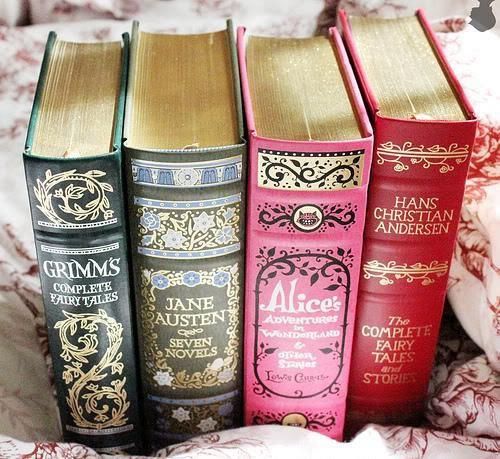
As part of our book club this month, I thought I would share some additional resources of books similar to Jane Austen's Sense and Sensibility for further reading.

Image via weheartit
There are obvious starting points such as Jane Austen's other famous works like Emma, Pride and Prejudice and Mansfield Park, but here is a list of some other works (and films) that will satisfy your Regency-era period piece cravings:

Films:
Les Miserables (1998): A Regency-era piece set in France during the French Revolution
Becoming Jane (2007): A film dedicated to the woman behind the novels, Jane Austen herself
Jane Eyre (2011): Another famous British female author whose characters also lived in the Regency period
The Duchess (2008):  While Georgiana, Duchess of Devonshire, lived in the decades prior to the Regency period, this is nonetheless a gorgeous period piece about a contemporary of Marie Antoinette and an ancestor of both Diana Princess of Wales and Sarah Ferguson.
Clueless (1995): A modern interpretation of Austen's Emma
From Prada to Nada (2011): A modern, Latina rendering of Sense and Sensibility

Novels:
Eliza's Daughter: A Sequel to Sense and Sensibility by Joan Aiken
Colonel Brandon's Diary by Amanda Grange: A novel examining the life of Colonel Brandon before, during and after he meets the Dashwood sisters
The Cookbook Collector by Allegra Goodman: A modern story of two sisters with shades of Austen's original work
The Jane Austen Book Club by Karen Joy Fowler

Non-fiction:
Jane Austen: A Life by Claire Tomalin
The Jane Austen Handbook: A Sensible Yet Elegant Guide to Her World by Margaret C. Sullivan
Jane Austen: The World of Her Novels by Deirdre Le Faye

Have you read any of these books or seen any of these movies?  Any additional resources you'd recommend?  Let's hear it!

Wednesday, March 16, 2011

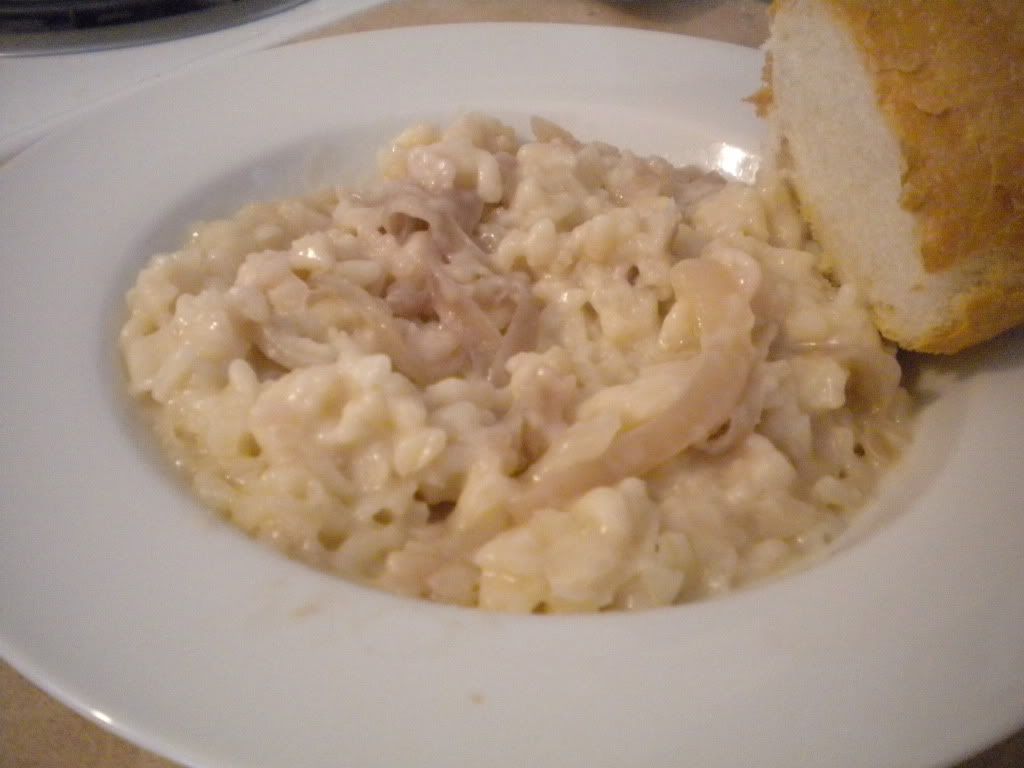
Blue Cheese-Caramelized Onion Risotto

It's funny, when I made this I didn't ever expect to share the recipe as I was just using up leftovers from the night before (we had these blue cheese stuffed burgers from Emeril that we topped with caramelized onions) but since quite a few people have asked for it, here it is!

Blue Cheese-Caramelized Onion Risotto


Ingredients:
4 cups chicken stock, I used cans of chicken broth we bought in bulk at Sam's a while back
4 tablespoons butter, divided1/2 medium white or yellow onion, chopped
1 cup uncooked Arborio rice or other short grain rice
1/2 cup white wine
1/2 red onion, sliced
2 tablespoons brown sugar
1/2 cup crumbled blue cheese
2 tablespoons half and half


Kitchen Supplies:
Small skillet
Wooden spoon
6 cup measuring bowl (for stock)
Medium stockpot
Measuring cups, assorted sizes


Melt two tablespoons of butter in small saucepan over medium-medium low heat.  Once melted, add red onions and saute.  Salt liberally to draw out some of the liquids in the onions which will start the caramelization process.  Sprinkle brown sugar and toss well to combine.  Reduce to medium-low heat and let cook while you prepare the risotto, stirring occasionally.


In a medium stockpot, melt remaining two tablespoons and add onions.  Saute for three minutes. Add rice, sauteing for two minutes until the ends of the rice start to become translucent. Stir in white wine to deglaze the pan. Stir constantly until liquid is absorbed, approximately one minute. Stir in 1 cup of broth mixture and cook for five minutes or until liquid is nearly absorbed, stirring constantly. Reduce heat to medium. Add remaining broth mixture, 1/2 cup at a time, stirring constantly until each portion of broth is absorbed before adding the next. This will take approximately 25 minutes in total.  Reduce heat and stir in blue cheese, caramelized onions and half and half.  Remove from heat and serve.


Previous times I've made risotto, I've kept the stock warm in a small saucepan on the stove and added the warmed stock to the pan.  The last two times we've made it we did not warm the stock and it turned out just as creamy and delicious as ever--so why dirty another pan if you don't have to?


The resulting flavors are a bit sweet from the onions, tangy from the blue cheese and creamy from the risotto grains that you lovingly stirred and tended to for the last half hour.  Delicious!


Do you ever make risotto?  What are your favorite add-ins?  We keep a two pound bag of arborio rice in our pantry at all times so I am always looking for new recipes!


P.S.  Since I'm eating leftovers of this for lunch today and have been for the past few days (that's where the photo came from) and it's Jenn's birthday, I will be linking up with her for What I Ate Wednesday again this week!


Film vs. Fiction: Sense and Sensibility

As part of our ongoing discussion this week of the Jane Austen novel, Sense and Sensibility, I thought it would be fun to compare the novel and a film adaptation side-by-side.  There are several versions out there, but probably the most famous and well-known among popular audiences was Ang Lee-Emma Thompson's film adaptation in 1995--which is the one we are looking at today.

First, can we talk about how wide and varied Ang Lee's directing career has been?  He has directed everything from a film set in 1960s New York which follows the formation of Woodstock Music Festival (Taking Woodstock) to the harsh, vast open ranges of Wyoming, exploring the taboo love between two gay cowboys (Brokeback Mountain) to the high society of England's Regency period (Sense and Sensibility) and the enchanting world of Western China (Crouching Tiger, Hidden Dragon).  According to IMDB, he is set to direct and release an adaptation of the book Life of Pi sometime in 2012 as well.

Now, here are some basic statistics about the film and novel.

Novel
Written by: Jane Austen
Year first published: 1811
Native language: English
Where it was written: England
Number of first editions sold: 750 books

Film
Directed by: Ang Lee
Screenplay written by: Emma Thompson
Year released: 1995
Native language: English
Where it was filmed: England
Box office success: $42,993,774 (US only)

Additional/Missing characters
  • Margaret Dashwood: youngest sister to Elinor and Marianne.  Has a much larger role in the film than in the novel.  In the film she is one of the first to befriend Edward, showing a softer side to him than is revealed in the novel.
  • Harry (Henry) Dashwood: Son of John and Fanny Dashwood.  Omitted from film.
  • Lady Middleton: Wife of Sir John Middleton.  Omitted from the film.  In the film he is a widower and lives at Barton Park with his mother-in-law Mrs. Jennings.
  • Anne Steele: Lucy's older sister.  Omitted from the film.
Missing Major Plot Points
  • Edward does not visit Barton Cottage until he proposes to Elinor in the film version (unlike in the novel where he visits and is melancholy which is later attributed from having left Lucy in Plymouth).  Upon their departure from Norland, Elinor does not see Edward again until the awkward scene when he calls on Elinor to find his current fiance and potential love interest in the same room.
  • Willoughby's explanation of himself to Elinor.  My jaw literally dropped when he came to Elinor to explain his side of the story as this appears nowhere in the film and I had no idea it was going to happen.  Ironically, although we better understand his motives and actions through the scene, it made me like him even less!
  • The viewer never learns that Marianne and Elinor remain neighbors at the close of the film as they do in the novel when Edward accepts the parsonage at Delaford (Marianne and Colonel Brandon's home).
Source
Artistic Liberties
  • Ages of Elinor and Marianne.  In the film version, Emma Thompson plays a 27 year old Elinor (Elinor is 19 in the novel). Ang Lee allegedly insisted Thompson play Elinor, despite the fact she had hoped sisters Natasha and Joely Richardson would play the key roles, to better help modern audiences feel the desperation of Elinor in love (since at 27, she would have been facing spinsterhood).
  • In the novel, Elinor verifies that Lucy Steele is telling the truth about Edward by observing a small portrait of him that she carries with him.  In the film, she has an embroidered handkerchief with the letter F, a handkerchief Elinor also carries.
  • In the film, Edward tries to tell Elinor about Lucy the day they leave Norland but is interrupted by Fanny, who fears he might be trying to propose to Elinor.
  • Edward's Proposal to Elinor.  This is my favorite scene of the entire movie and I was a little disappointed that it appeared nowhere in the novel: "Elinor, I met Lucy when I was very young.  Had I had an active profession, I should never have felt such an idle and foolish inclination.  My behavior at Norland was very wrong but I convinced myself that you felt only friendship for me and that it was my heart alone that I was risking.  I've come here with no expectations only to profess now that I am liberty to do so, that my heart is and always will be, yours."
Source
  • Lucy unloads her secret about Edward on Elinor almost upon meeting each other.  In the film, they are not on a walk but rather in a drawing room when the secret is shared.  Mrs. Jennings (who is as nosy in the film as she is in the novel) starts to suspect something due to their engrossed whispering and questions the girls.  Lucy quickly lies and says they were speaking of London and "all of its diversions."  At this point, Mrs. Jennings and Charlotte invite the girls to London.
  • In the film, Lucy Steele reveals to Fanny that she and Edward are engaged after Fanny befriends her and convinces her to tell her secret, promising she is "as silent as the grave."  The scene that follows is hilarious as Fanny upturns the table they are arranging flowers on and removes her by pinching her nose!
  • At the end of the film, the viewer sees Willoughby watching from his horse as Marianne and Colonel Brandon marry and the town celebrates, regret written all over his face.
 Fun Facts
  • Emma Thompson met her husband Greg Wise (Willoughby) on the set of the film.
  • Thompson spent four years writing the screenplay and at one point when her computer crashed, friend Hugh Laurie (of House fame) and Stephen Fly helped her recover a version of the screenplay.  They are thanked in the credits for their help.
  • Jane Austen originally published the novel in three volumes and titled it Elinor and Marianne under the pseudonym "A Lady."
  • Sense and Sensibility was Jane Austen's first full-length novel.
  • Austen paid for the book to be published and paid the publisher a commission on the sale, in an amount that was approximately a third of her yearly income!
Final Comment

After reading the novel and rewatching the film, I can really appreciate how artfully Emma Thompson used dialogue in the novel in her screenplay.  I believe that it was this use of dialogue that helped lend a truly "Austenian" voice and feel to the film.

Example (novel dialogue):

Fanny: "What brother on earth would do half so much for his sisters, even if REALLY his sisters! And as it is--only half blood!  But you have such a generous spirit!
John: "I would not wish to do any thing mean.  One had rather, on such occasions, do too much than too little.  No one, at least, can think I have not done enough for them: even themselves, they can hardly expect more."
Fanny:  "There is no knowing what THEY may expect but we are not to think of their expectations: the question is, what can you afford to do..."
John: "That is very true, and therefore, I do not know whether, upon the whole, it would not be more advisable to do something for their mother while she live, rather than for them--something of the annuity kind I mean..."
Fanny: "To be sure, it is better than parting with fifteen hundred pounds at once.  But, then, if Mrs. Dashwood should live fiften years we shall be completely taken in..."
John: "Fifteen years! My dear Fanny; her life cannot be worth half that purchase."
Fanny: "Certainly not; but if you observe, people always live for ever when there is an annuity to be paid them."

(film dialogue):
Fanny: Help them what do you mean help them.

John: Dearest i mean to give them 3000 pounds.  The interest will provide them with a little extra income.  Such a gift will certainly discharge my promise to my father.
Fanny: Without question.  More than amply.
John: One had rather on such occasions do too much than too little.  Of course, he did not stipulate a particular sum.
1500 then.  What do you say to 1500?
Fanny: What brother on earth would do half so much for his real sisters? Let alone half blood.
John: They can hardly expect more.
Fanny:  There's no knowing what they expect.  The question is, what can you afford?
John: A hundred pounds a year to their mother while she lives.  It is better than parting with the 1500 all at once.
Fanny: What if she should live longer than fifteen years?  You'd be completely taken in.  People always live forever when there is an annuity to be paid them.
John: Twenty pounds now and then will amply discharge my promise, you're quite right.
Fanny: Indeed!  Although to say I am convinced that your father had no idea of you giving them money...

This was a very long blog post but I so love Sense and Sensibility that I couldn't help myself!  Hopefully you don't mind!!

Have you seen the movie?  How does you think it compares to the book?  Or better yet, what is your favorite scene?

Tuesday, March 15, 2011

Visit: Cahokia Mounds

Saturday after filling up with some delicious First Watch breakfast (courtesy of a gift card), J and I headed over into eastern Illinois to see Cahokia Mounds and took advantage of some of the warm weather we were having at the time.

He had visited before but since I had never been, he returned with me to explore the site.  I will share some of the photos I took while we were there but know that they do not do the site justice by any means!

A view of the Mississippi from the top of Monk's Mound
The area was inhabited by a tribe of Native peoples who researchers refer to as Mississippian people from approximately 700 CE until 1400 CE in the largest settlement in the Americas north of Mexico.  At its height in 1250 CE, the area had more inhabitants at the time than London and would hold the record for largest American settlement until 1800 CE when it was finally broken by Philadelphia!

Just as European cities at the time began to see the division of labor and professionalization of skills and trades, researchers have found evidence that a similar division of labor occurred in this settlement (think spear makers, potters, and other crafts people).  Yet sometime around 1200, for reasons that are not entirely clear to researchers, the settlement fell into a decline and was completely abandoned by 1400 CE.  Some likely causes for this decline include overcrowding, depletion of natural resources, war, disease, social and political unrest or more likely, a combination of these forces that brought about the end.

The word Cahokia is a bit of a misnomer because it refers to a group of native peoples who inhabited the area in the 17th century, long after the settlement had been abandoned.  In the mid 18th century, local historians suggested it be called Cahokia Mounds to honor the 16th century natives. 

J and I discussed this quite a bit as we were walking around and the popular perception of native peoples is that of nomadic, "uncivilized" people.  Places like Cahokia Mounds demonstrate how far this popular opinion is from the truth. 

The site itself consists of a museum, gift shop and the grounds themselves.  While the natives built over 120 mounds, only one is fully accessible to visitors due to issues with erosion and so forth.  As you look through these photos, keep in mind that each of these mounds were created by human hands and tools.  Pretty amazing right?!

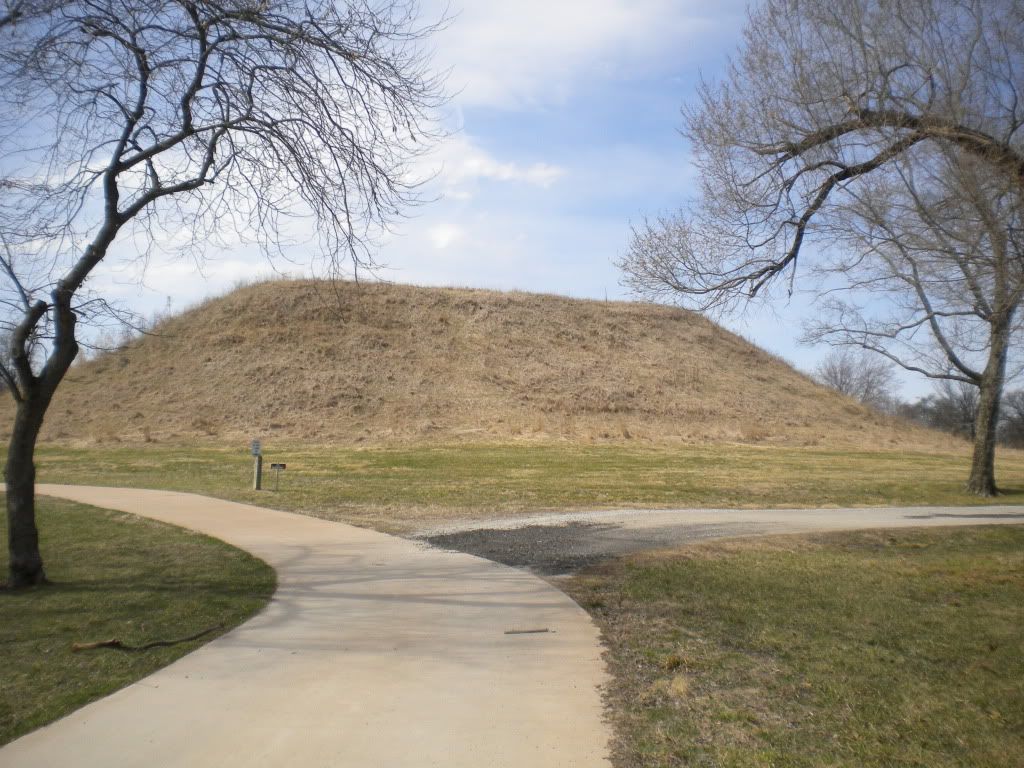
One of the many mounds at the site (now a state park).  You can see how erosion has taken its toll on these earthen mounds over the centuries.
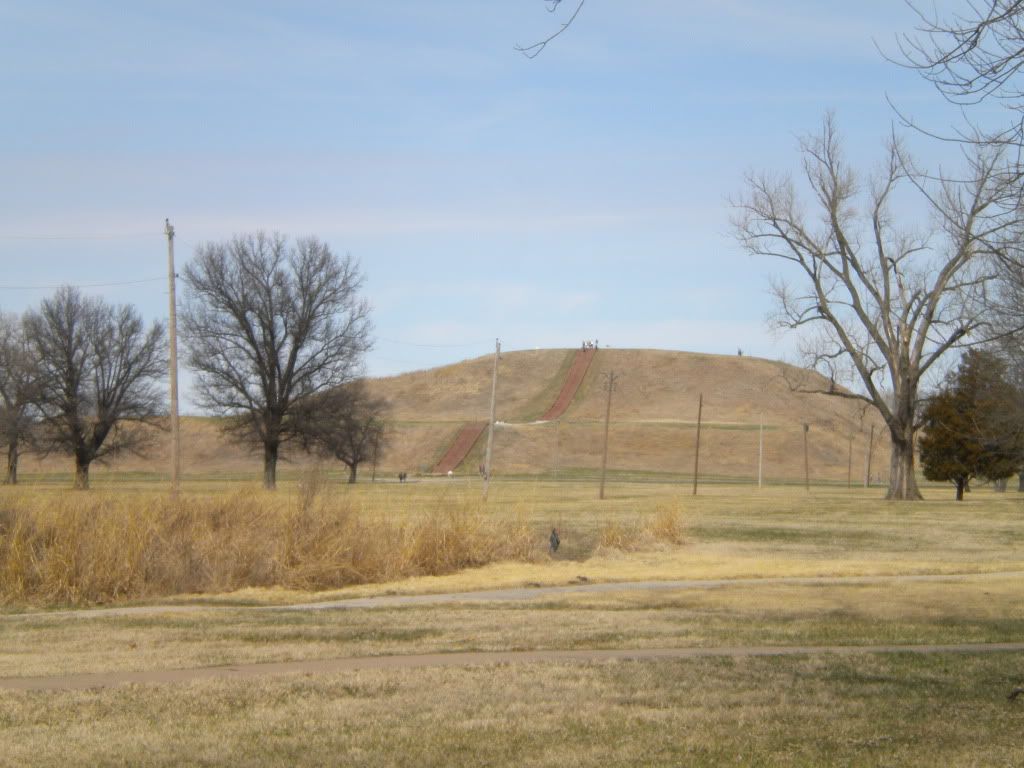
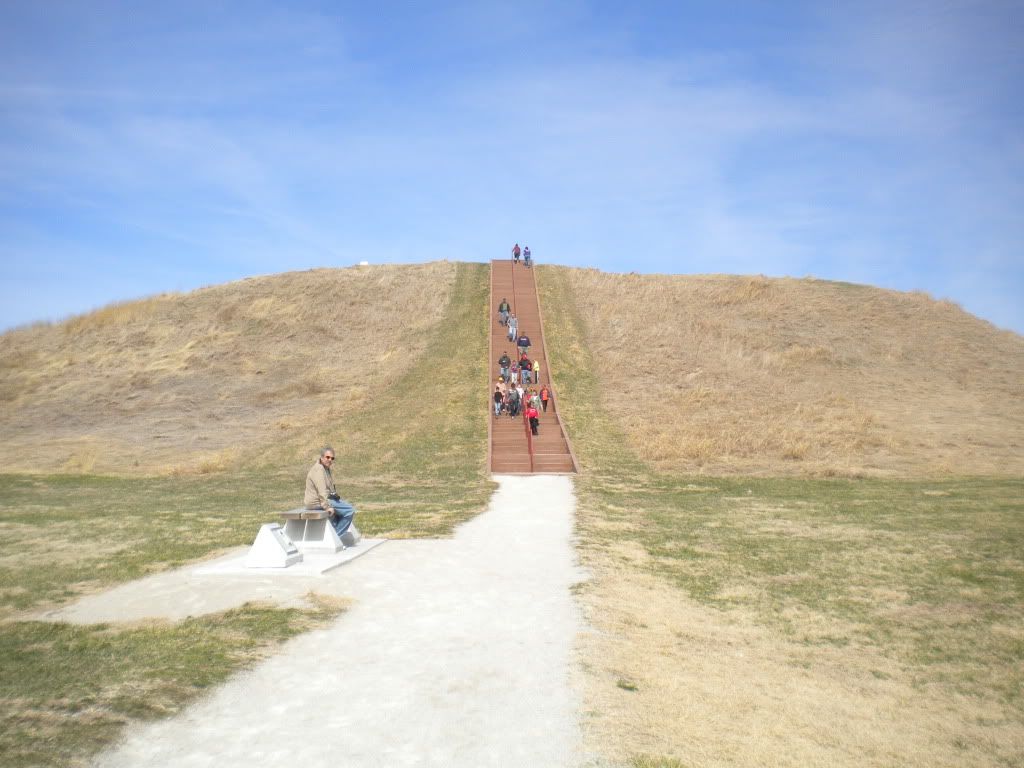
A look as we approach the largest mound, Monk's Mound. The settlement's leader lived and ruled from a wooden structure that was built on the top of this mound. 
Halfway up Monk's Mound.
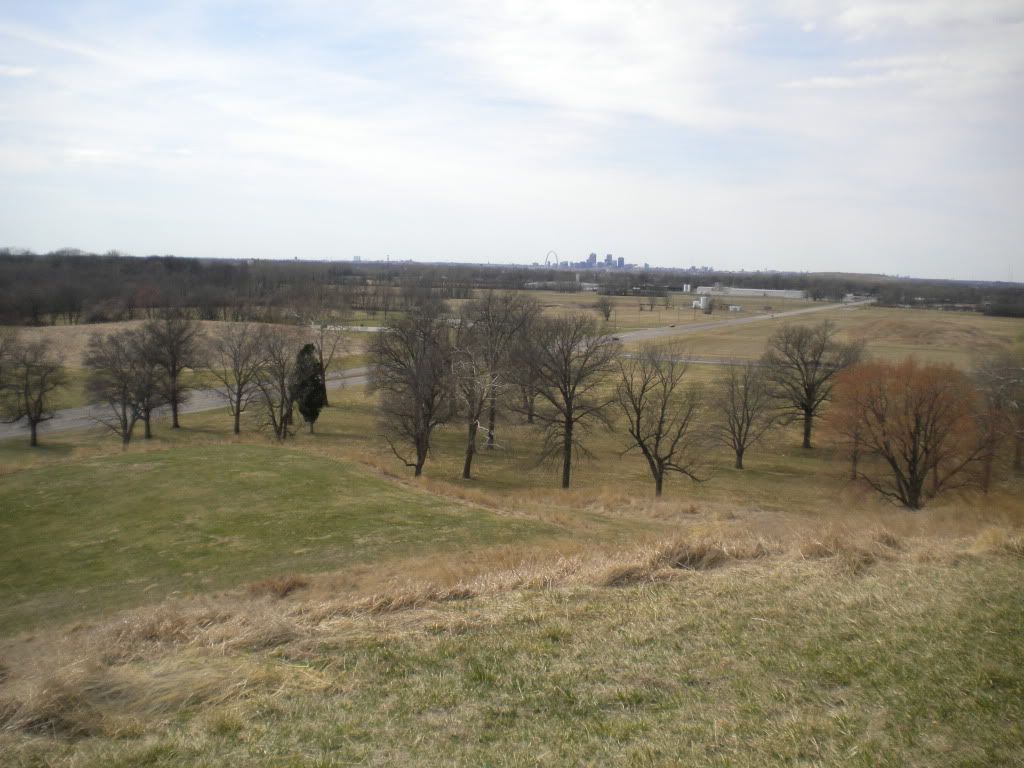
A view from the top. This gives you a better idea of how big these mounds actually are since we are at least 12-13 miles away from downtown St. Louis. 
Zoomed in view of Downtown St. Louis from the top of the mound
This was a great place to visit and I would encourage everyone in the area to check it out, especially as the weather starts to get warmer (hopefully).  Since I am not a native of Missouri, I really enjoyed learning more about its history!

Many have compared the settlement to Chichen Itza in Mexico.  My question to you is: Have you ever been to Mexico and seen them in person?  What about Cahokia Mounds or other local (St. Louis or not) treasures?  I'd love to hear (and learn) all about them!

Book Review: Sense and Sensibility

I have never been a big fan of Jane Austen's writing.  There I said it.  In high school, we read several of her novels including Pride and Prejudice.  I tried my best to follow along but never developed the sort of passion for her works, especially P & P as it became known at school, that my fellow classmates did.

Girls would wax poetically about Mr. Darcy and how dreamy he was and how romantic the novel was and I just sat there, scratching my head.  For most of the novel, he was very mean to Elizabeth Bennett and frankly, I felt as if he did not deserve her.  Now Colonel Brandon (and to a lesser extent Edward Ferrars), there was a character where I could understand the infatuation.  His constancy of affection throughout the novel is admirable and endearing and he becomes a sort of good guy who you are rooting for to get the girl by the end of the novel.

For those of you unfamiliar with the book or various film adaptations, Sense and Sensibility follows the story of two young women in the Regency period of England, so called because at the time King George III was deemed unfit to rule and his son, the Prince Regent, ruled by proxy.  Elinor Dashwood, the elder sister, represents sense, logic and restraint while Marianne Dashwood, the younger sister, represents sensibility or romanticism, a sort of girl who puts the feelings of her heart over what is socially acceptable, in a time that had very rigid rules, especially for women, on propriety and courtship.

Source
Like in Pride and Prejudice, the Dashwood sisters have little money, largely due to inheritance practices of the time (including male primogeniture) at a time when marriages were made largely for the monetary benefit that came with them.  And like Pride and Prejudice, this lack of funds and position presents problems for the Dashwood sisters when it comes to love.  The novel follows their struggles and ultimately successes in finding love.

As I noted in this post, I loved the book and found it very enjoyable to read!  The mix of dialogue and prose seemed more equal in this novel than in Pride and Prejudice, which may be one reason I enjoyed it more.  It was still not as close to the balance we are used to as modern readers (Austen's works are much heavier on prose than dialogue, telling you who the characters are or what they are thinking instead of revealing some of these truths through dialogue) but it is not so distracting or boring as to slow down the reading of the book.

I felt the middle dragged slightly, especially considering how long it took Austen to get the sisters to London.  Having seen the movie dozens of times, I knew there was a great deal more to the story after they arrived in London and I was anxious for the characters to get there!  On the flip side, I felt that the ending took far too little time to tie up all the ends--it was as if Austen was done with the story and trying to tie it up as neatly as possible in as little time as possible.  This is a criticism I have had of books before, so this might be more of a personal preference thing.

I felt that Austen did a great job fleshing out even the minor characters, like Lady Middleton, Mrs. Jennings and Mr. John Dashwood.  Her descriptions and the dialogue she wrote had me laughing at loud at times, especially when it came to the greedy and petty nature of Mr. John Dashwood.  One could definitely see why Jane Austen is known for her acerbic wit and social commentary!

Speaking of social commentary, many of critiques she dishes out could easily be applied to modern day life as well, especially those involving money, greed and social status.  This is a tribute to Jane Austen and a testament to why these novels continue to be so popular among modern audiences.  Her characters and their plight are relatable and approachable, even if you know nothing about the time and place in which they are set.

So, if you are looking to read a Jane Austen novel and have been intimidated by her works and the writing style before now, might I suggest you start with Sense and Sensibility?!  You might actually enjoy it.  I know I did!

P.S. Today I'm featured over at Aiukli-Because Life is Beautiful.  Check it out here!

P.P.S. As fate would have it, I wrote about Japan and how it is one of the places I most want to visit just days before the earthquake and tsunami.  Like many people across the globe, my thoughts and prayers are with the Japanese people as they struggle to rebuild.

Monday, March 14, 2011

The Terrible, No Good, Very Bad Day or Was It?

I am convinced there is nothing a glass of wine, bubble bath, Trader Joe's Chicken Tikka Masala and a long talk with your mom can't fix.

Case in point:

  • I woke up to snow this morning--never mind that it was 60 degrees or so on Saturday!
  • I was at work late and exhausted after a busy day with lots of ringing phones.
  • My phone stopped working and after spending 2 hours at the Mall between the AT&T and Apple store, it inexplicably started working again.  
  • It was still snowing/sraining (combination of rain and snow) when I left the mall at 7:30.
  • I arrive home too exhausted and frazzled to cook anything, let alone the dinner I had planned for tonight.
Image via weheartit

And yet.  And yet...Bad day?  What bad day?!

It's Back: Menu Monday

It has been over a month since I've shared what's on our menu this week.  I think it's time we change that, don't you?

Here's what on our menu this week:

Image via weheartit

Sunday: Caramelized Onion and Blue Cheese Risotto
Monday: Cauliflower and Walnut Cream Soup--recipe and photos to follow
Tuesday: Homemade pizza night
Wednesday: Leftovers
Thursday: Horseradish Crusted Corned Beef and Cabbage with green beer--recipe and photos to follow
Friday: Fish Fry

Week Day Breakfast, Tropical Muffins and Chai latte--recipe and photos to follow


What's on your menu this week?